Go Beyond, and Tow Back Home.
We’re about halfway to our camping spot in the Western Sahara. The desert stretches out in front of us, in shades of brown, beige and yellow, with a few dots of green and some mountains in the distance. The Land Rover packed to the brim with tents, folding chairs, food, sleeping bags and mats. It’s Owner, Nico, is driving. My friend Arnaud, who brought me along for the ride, is sharing the back seat with Dot, Nico’s dog, a few gallons of water and a bag of fragrant flat bread. The guys discuss the benefits of different 4x4s. Nico is a Land Rover fan, Arnaud has switched to a Nissan. “I like the Land Rover though, maybe I’ll keep it after all,” Arnaud muses. I’m in the passenger seat trying to find music on my phone that will satisfy all ears, when suddenly the Land Rover coughs and stops. "Hm, weird," Nico mutters. He restarts the car, we continue driving. A few minutes later, the same thing happens on an incline. Nico restarts, we continue driving. Just as I hit play on “Ring of Fire”, the car slows to a halt. But this time, the Land Rover won’t budge. Nico turns the key in the ignition, working the pedals with his naked feet. Nothing. He lets out a frustrated groan.
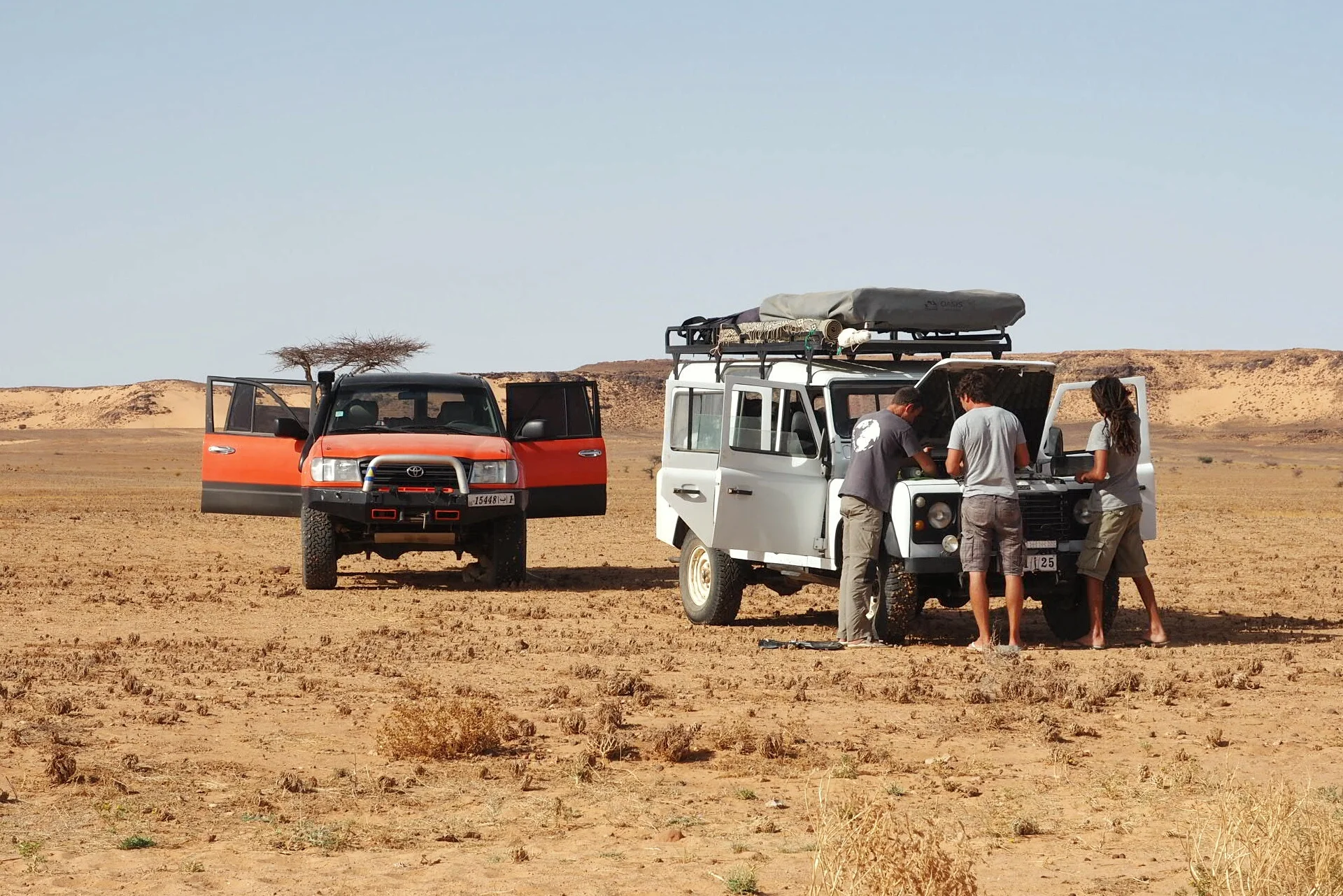
The red 4x4, which has been following us for the last few hours, pulls up behind us. Abdul’s and Sophie’s Toyota is almost as crammed as our Land Rover, but their dog has the backseat to herself. Abdul walks over, while Nico, with a worried look on his face, is already propping open the hood. Arnaud joins them; the three men peer into the engine and start prodding. “Maybe it’s the filter,” Abdul suggests. “Maybe. I have a spare one that we can use.” Nico digs into the middle console and pulls out a cardboard box. “Let’s try it.” Given that I know nothing about cars, I join Sophie in the shade under a nearby tree. It’s part of a dried out riverbed, the only strip of land that has any vegetation that is more than a few inches tall. “If we need to, we could just camp here. It’s pretty nice,” she observes. I agree, and lie down on my roll mat. The landscape is stunning, the heat making the colors dance in the distance.
An hour later I’m waken up by Arnaud. We’re ready to move on - the engine still doesn’t start up, but Nico wants to tow the Land Rover to the homestead of a nomad family he knows. He thinks he could leave the car there if needed, and return from the city with a mechanic in a couple of days time. Problem is, the ground in this part of the desert is soft, not ideal to tow on. And the Sahrawi family lives at least an hour away, across a few riverbeds with deep grooves and bumps amidst the shrubbery. We deflate the tires of both cars to give them more grip in the sand, and connect the Land Rover with the Toyota. By foot, Nico scouts out a path through the river bed, a faint track where other vehicles have driven before. Then, we take speed. Nico is in the front, giving directions to Abdul, who puts his foot on the gas. I’m in the back with Arnaud, who is trying to anticipate the Toyota's movements and change in velocity so as not to rupture the towing rope or get stuck in a dune.
By a mix of luck and boldness, we make it across the first river bed as well as the second, and up a slope. Then, night falls and we decide to take a break and have a drink. By now, the two hooks on the back of Abdul’s 4x4 have given out and we had to reattach the towing rope below the bumper. The connection is a bit more precarious than before. “It’s not far now. See the mountain over there? That’s where the family lives,” says Nico. We cheers to that. It’s pitch black by the time we arrive at the two Bedouin tents. A guy in his twenties and an older man come out to greet us. They don’t seem surprised. The young man, I am told, is the son of the family who owns the livestock, the goats and around fifty dromedaries that are kept close by. The older man is a shepherd and works for them. We share dinner with our host - pasta and meat heaped onto a communal plate. Everyone digs in.
The next morning, I step out of the dim Bedouin tent into broad daylight. The young guy, who’s name is Salama, is already covered in grease. He and Nico, with Abdul and a neighbor who has stopped by, seem to have been working on the engine for a while. “The pump’s gone,” Abdul tells me, “they are trying to feed the gasoline directly into the engine with that hose”. He points towards a see-through plastic hose that Salama is currently feeding into the tank. He sucks on one end until the gasoline stars flowing. It spatters onto his shirt before he feeds the tube into the jerrycan at his feet. “That guy’s crazy. He’s drunk at least a liter of gasoline in the last hour,” Abdul comments. We watch him take the Land Rover’s passenger seat and holds the jerrycan out of the window, while Nico connects the tube to the engine. Nico then starts the car. It sputters, then moves forward. The construction works! They drive a few meters, then return to fix the improvised fuel tank on the Land Rovers roof to make it more practicable for the ride home.
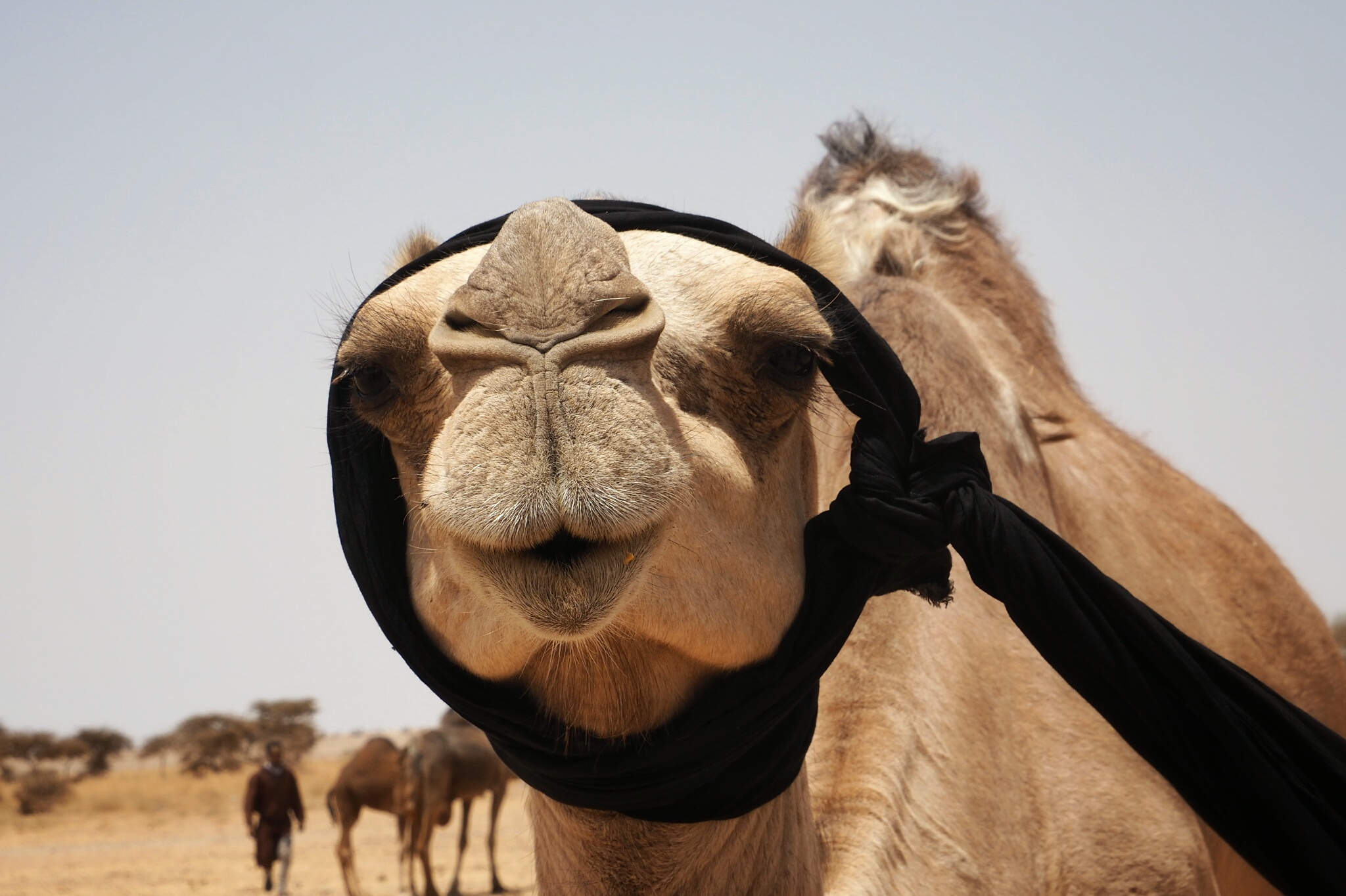
Soaked in gasoline, Salama walks over to us and casually lights a cigarette. Do we want to see his herd before we head off? Sure thing. In Abdul’s car, we drive a short distance to the well where the dromedaries are being watered by members of Salama’s extended family. There seem to be a lot more than 50 animals. In a weird way, they look both graceful and clumsy, with their long but slightly x-shaped legs and bellies that, if seen from the side, resemble wondering dunes. Their facial expression conveys a certain annoyance, especially when one of the Sahrawi catches an animal with his Shesh to make it pose for pictures.
You lookin' at me, baby?
By the time we are finally on our way home, it’s already boiling hot. Probably high 30s. At first, the Land Rover is making good progress - not fast, but steady. Through the windscreen I can see the yellow gasoline flow from the tank to the engine. Then, more and more bubbles appear in the pipe. The engine stops. The jerrycan, it turns out, is empty. The construction is leaking, gasoline is smeared across the windscreen and the doors. Abdu climbs on the roof to fill the tank up once more, but the fix doesn’t last long. After three hours we have made hardly any progress, and finally run out of gasoline for the Land Rover. We decide to go back to towing. Certainly until we hit the road, maybe all the way back to the city - all 150km.
Hours later, as the sun is setting, we pull into the parking lot on the outskirts of Dakhla, after having passed one police and two gendarmerie checkpoints. Nobody stopped our convoi - at least not for long. The gendarmerie only took an interest until we had paid the "fine" for towing outside of the city. "We made it!," high fives all around. Dot, exhausted from the heat, barely lifts her head. We unload the camping gear which, although we haven’t used it, is covered in dust. My body, too, feels like I’ve just spent a week without shower, covered in a slimy mix of sweat and dirt. As we take out the last few items from the Nico’s car, Arnaud nods towards the 4x4 parked next to us, a Land Rover with the logo of Arnaud’s company on it. “I guess I’ll sell it after all,” he grins.