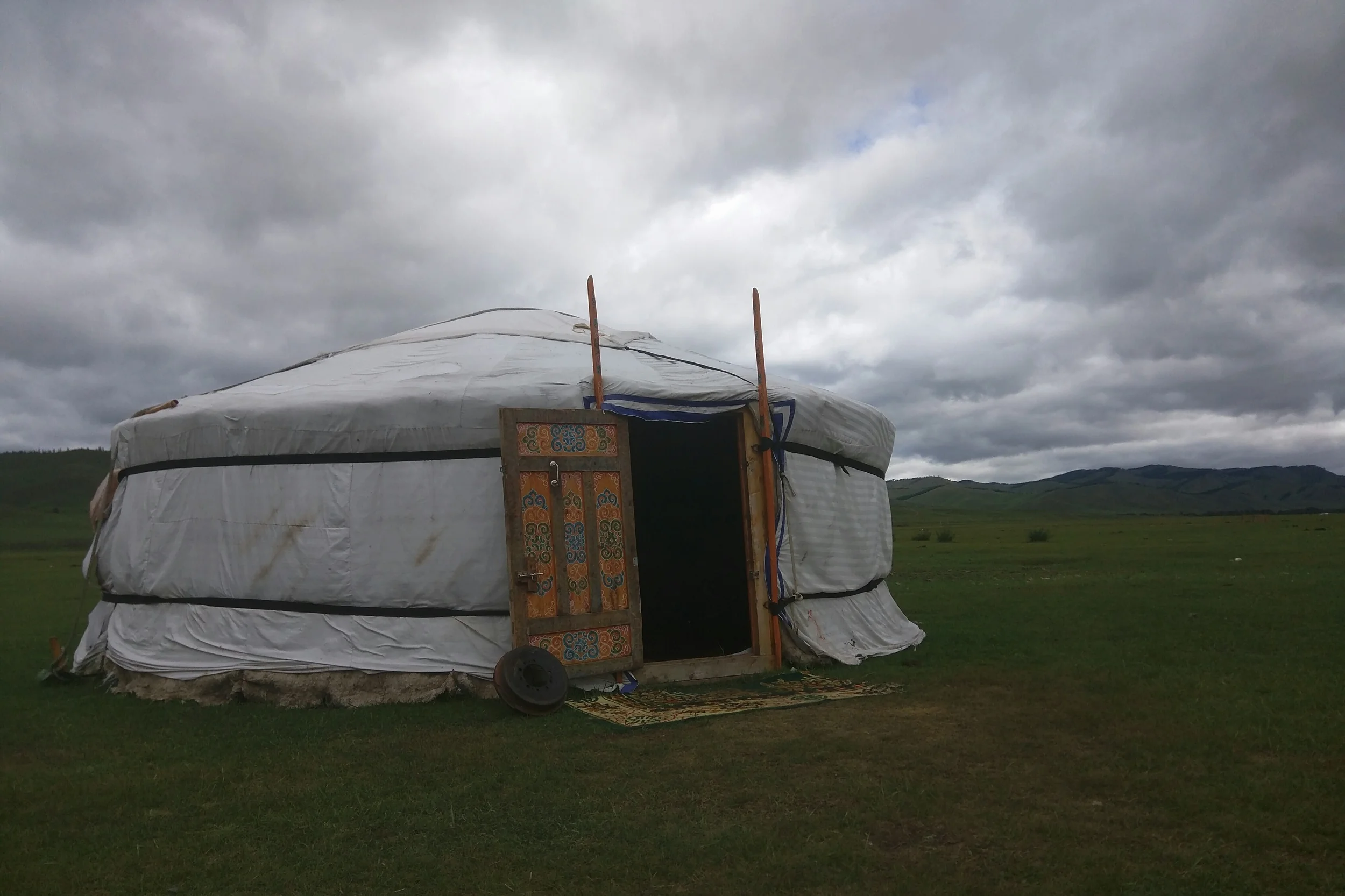
Mongolian Gers
The train from Irkutsk to Mongolia definitely saw its best days back in the seventies. The cabins were smaller, the loos pedal-operated and the restaurant car was decked out in brown-in-brown design. However, it was actually quite comfortable to be riding in this rattling time machine. The beds were fairly comfortable, and once we’d survived the 4 hour ordeal of Russian and Mongolian border control and customs, we were rocked to sleep as the train crawled to Ulan Bator.
The capital of Mongolia is not a beautiful city. In the hot summer temperatures it’s quite dusty, and a large number of mostly Soviet-era houses seems to sprawl without much plan until the city fizzles out in suburbs that consist predominantly of the traditional Gers and wooden shacks. However, almost a third of Mongolians live in this city which only introduced street names a couple of names ago. The cab driver I caught from the train station to the hostel actually didn’t know any street names I mentioned, but asked his way around until he we arrived at my destination in a courtyard adorned with a playground that had withered away from decades of exposure to the elements.
After spending, one night at the hostel, and then caught a bus to Terelj National Park. I had booked a trip with a local “sustainable” travel organization called Ger to Ger, and suffered through a 2.5 hour introduction session on the day of my arrival. I’m all for giving travelers some background info and pointers, but an introduction that started with Ghengis Khan and included stories of heroic endeavours the founder of Ger to Ger had survived, seemed a little too much.
At the final bus stop in Terelj I was picked up by a girl with an oxcart, and - through a couple of small rivers that we crossed with a furt - was taken to the first ger, where the lady of the house welcomed me and served lunch (milk tea and fried rice). She told me that she was a shaman, but she didn’t seem very shamanic to my untrained eyes. For the hour I was there, she watched a Korean Soap Opera synchronized into Mongolian on a tiny TV powered through a solar panel, while I was trying not to make any of the cultural blunders I was warned of in the introduction session. I thus diligently sat on the West side of the Ger, finished everything I was given to eat, and had lots of milk tea. Then her husband arrived, slurped down his lunch and motioned me to put on long pants - “horse, horse!”. The content of my backpack was transferred to two saddle bags, and I climbed onto one of the small Mongolian horses and into the incredibly uncomfortable wooden saddle. The next 2.5 hours, trotting through the national park, were both beautiful and by the end, very painful. I was certainly happy to arrive at the next ger where I would spend the night.
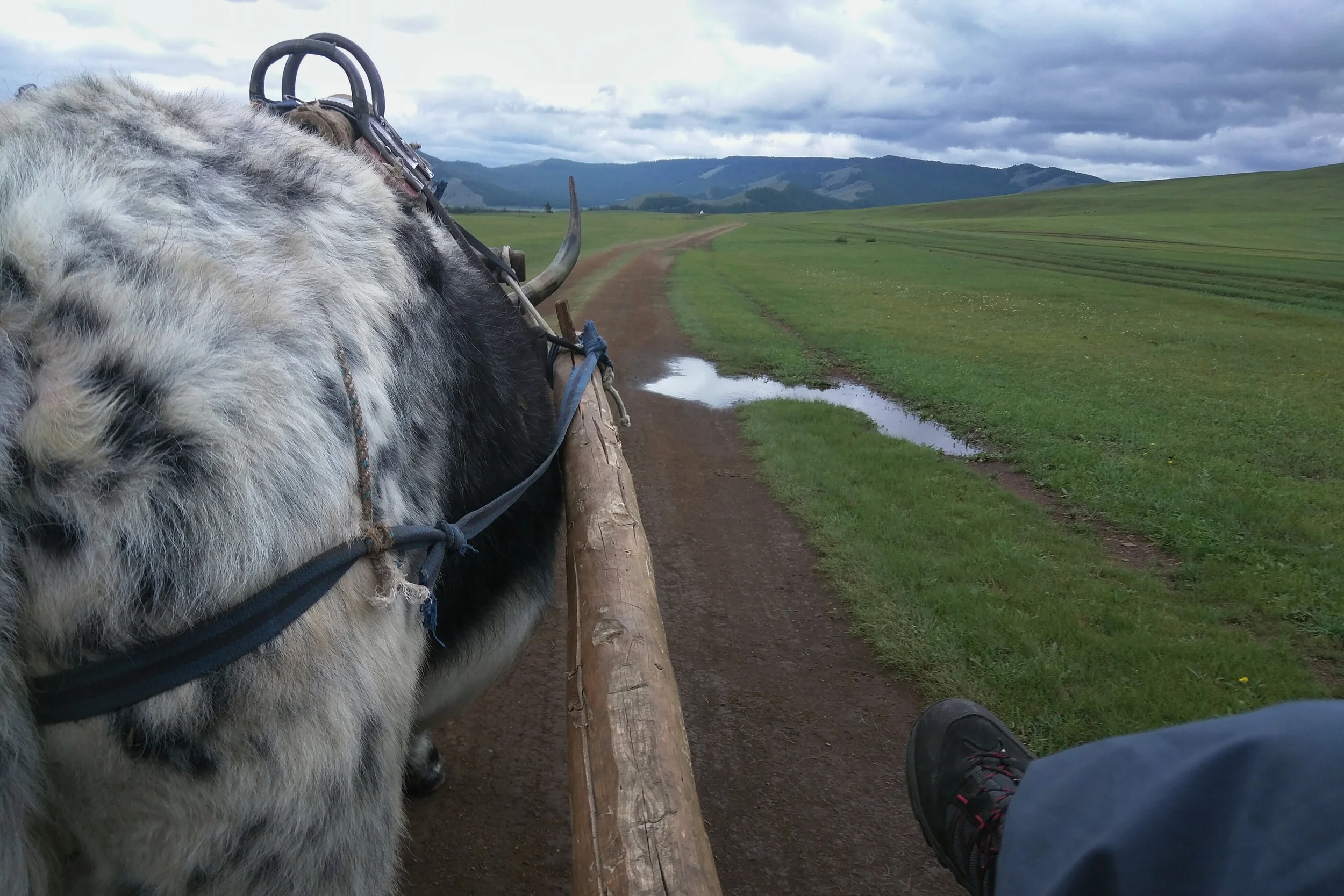
Oxcart idyll.
I spent the following two days in a similar fashion. Eat, eat more, be shuttled to the next family by horse or ox cart, sleep, eat, go for a walk. The nature is wonderful - quite lush and green, with a few small rivers undulating through the valleys, lined by sparse forest. A thirty minute walk will take you up to one of the rolling hills, from which one has an amazing view, with lots of valleys dotted with white gers up to the horizon. I did go for a few walks, considering there is not much to do apart from helping with the animals (goats, cows) in the morning and evening, and playing with the family’s kids and dogs. My feeling was that the herders looked at us tourists with bemusement - who would come from a far away country, only to want to help them complete their daily chores? Wouldn't we 'rich' people just want to sit in a nice hotel and be pampered? I did get the impression that for some of the families, tourists were in a similar category as their lifestock - and I don't mean that negatively. They just realized that tourists have to be fed at regular intervals, be given a place to sleep and a way to pass the time, and if you do it right you can make a nice living off of them.
The herders are also incredibly diligent, working from dusk till dawn with the animals, tourists and spending large amounts of time cooking and preserving animal products. I’m surprised people don’t suffer from malnutrition - the only vegetables I encountered were boiled potatoes. Other than that, we had rice, pasta, bread, meat, and lots of milk products - boiled milk (served as dinner with rice), “dried cream” (serve on bread), fresh cheese, dried cheese and yoghurt. I steered clear of the fermented horse milk I encountered in one ger, where it lived in a huge blue plastic container until some locals dropped by and bought gallons of the stuff. Apparently, Mongolians drink lots of this alcoholic beverage in the spring, to “clean out their system”. It certainly seems to have a cleansing function.
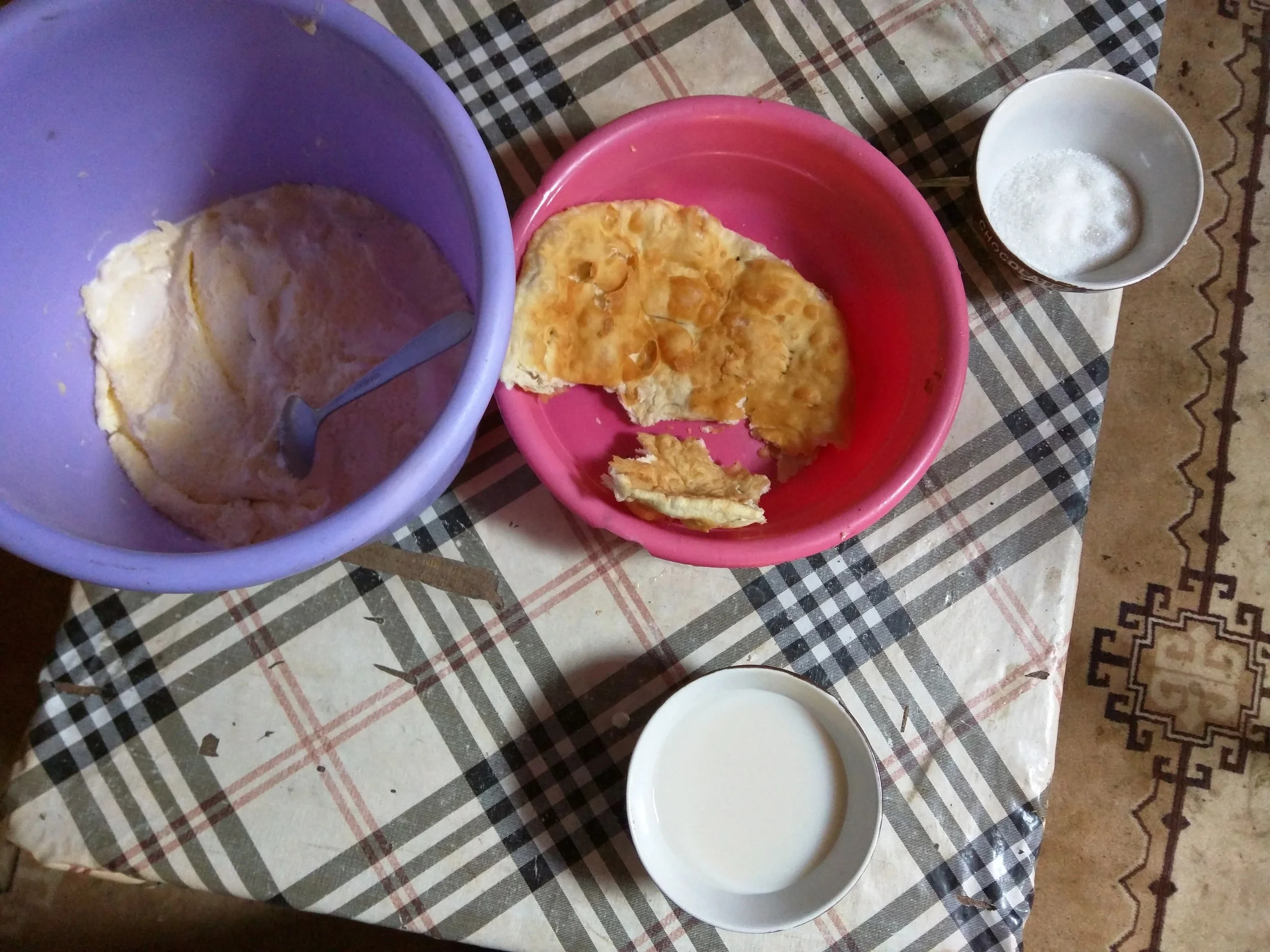
Breakfast - fried flat bread, dried cream, sugar and milk tea.
A 8 hour journey by ox cart, horse, ox cart, shared “taxi” (8 people to 5 seats) and bus took me back to the heat and dust of Ulan Bator, where I collapsed on the bed of the cheap hostel where I'm typing. The next train leaves tomorrow morning at 8am. A Chinese train, to Beijing, where I'll exchange milk products and salty tea for Peking duck and rice wine.