
Meeting the Gap
From September to December 2015, I worked as a Project Manager for a UK charity that focuses on youth leadership and sustainable development in developing countries. My first project was situated in Isiquí, a village in rural Nicaragua. The project’s goal was to rebuild the 28-year old water system, thus improving the water quality. The team consisted of myself and two other volunteer PMs, plus a group of 14 teenage Venturers. Once begun, we quickly noticed that the project was much less effective than expected.
Isiquí, it turned out, did already have access to potable water through water filters supplied by Rotary Club. Additionally, only a small part of the community actually engaged with our work and benefited financially from our presence in the village. In an effort to make the project more worthwhile, we decided to change host families to include poorer sections of the community. Our attempt, however, led nowhere, getting stuck in a web of local political and social ambitions. Having set aside three months of my time to contribute to what I hoped would be a worthwhile effort, I found that immensely frustrating. Isiquí seemed to represent, in a nutshell, what was wrong with what we call sustainable development, and how difficult it is to get help to where it is most needed - even on the level of a single community. One meeting in particular stuck in my mind. I wrote this blog post while I was still offline in Nicaragua.
Meetings, unfortunately, are an essential part of any project, anywhere in the world. This particular meeting I was sitting in had been called by our host mothers, who had heard rumors that we were considering changing host families for the second group of venturers, due to arrive in a couple of days. They were not amused. Taking things into their own hands, they had asked myself and the other two Project Managers, the village leaders Don C and Don H, and a representative of our local Project Partner to join them for a chat on Don C’s front porch. If it was up to them, the host families would remain unchanged.
We started off with greetings, and mutual confirmations of how much we enjoyed each others company. They had loved hosting us and the teenagers for the last few weeks, and we confirmed that everyone had felt very welcomed by the families. That being established, one of the host mothers got more specific. One of the reasons we had enjoyed our stay so much, she explained, was that the process of vetting host families was a long and arduous one, and that only the most suitable families of Isiquí had been selected. The village leaders nodded in agreement. With other families, they pointed out, they could not guarantee the safety and comfort of the venturers. Alcohol abuse was rampant, they suggested, surely we did not want the Venturers to be exposed to that kind of influence, especially since we were running a dry expedition? “Of course not,” I assured them, thinking to myself how strange it was that every other family in a village of 120 households had a drinking problem. Pleased, Don H shifted his weight: “Then why would you want to change host families?” Was it that we thought that the current families weren’t deserving of the extra income, just because they lived in the nicest houses in the village? Surely, we were aware that the stipend of 4USD per day and venturer did not cover the true costs of hosting them. “Yes,” Don C nodded in agreement, “4USD only pays for condiments on top of rice and beans”.
My fellow PMs and I glanced at each other. Truth is, we did not think they were “deserving” of extra income. To us it seemed as if only the richest families in town, all of which were related, had been chosen as host families. And they had hosted Venturers every year for the last two years. As for condiments - most households we had surveyed in Isiquí over the course of the project earned about 3000 Cordobas per month, which equates to roughly 4USD per day. With two Venturers staying with any one family, the 8USD stipend paid by our organisation to cover costs of food and shelter would triple average daily family income. This is why we wanted to change host families - to increase the project’s reach in the community, both economically and culturally. Isiquí does have some very poor households in its midst, which seemed to be left out of that particular benefit our project was bringing to the community. With new host families, the Venturers would experience a greater variety of homes and more locals would feel connected to our work in the community.
The village leaders, unfortunately, had a different plan. They seemed focussed on securing economic opportunities mostly for a small circle of friends and family, which may or may not have a positive side effect for the rest of Isiquí. Also, there appeared to be little interest in learning how to use their own skills and resources to improve things for the community. The expectation seemed to be that some NGO, one of the many active in the Miraflor region, would roll in to do necessary work: such as building eco-latrines, or installing a new water system. Which is ironic, since those projects involve mainly manual labor and very little of what we would call engineering. Indeed, the original water system we were replacing had been built by the locals. Clearly, with their skills in handling tools and knowledge of communal infrastructure, they would be much better equipped to complete them. At least better equipped than a bunch of teenagers who’ve never used a pickaxe in their life - led by three desk jockeys on a career break, equipped with a manual on gravity fed water systems.
Upon reflection, I found the meeting both fascinating and disconcerting. There we were, three people trying to “work in development”, just finding our feet. On the other side a community and a project partner clearly experienced in interacting with NGOs, playing the game on another level. They knew how to get development projects, and how to get the most out of them. The water system seemed to be reduced to a nice side effect to where the real action was happening, and there was very little we could do to change that. Once everyone present had assured us that it was impossible to change host families, we PMs grudgingly agreed to review our plans. “I think that is sensible,” the project partner agreed, “we don’t want to put anyone at risk”. The host mothers and village leaders nodded in agreement. Faced with so much resistance, we felt defeated. Every single alternative host family we had visited and suggested to the village leaders was ruled out as having a drunk in the same house. There was clearly no interest in widening the circle of beneficiaries of our project; it felt as if any attempt to increase its economic reach was thwarted by the community. Sensing our disappointment, Don C smiled: “Please know that we’re thankful for the work you’re doing in Isiquí. It is very important to us, and we want to support you”. For a moment, I felt we might be turning a corner. Then he continued, revealing a glimpse of the grander scheme of things. “For the next project, we’d love to get flushing toilets for the whole village. Maybe you can tell your organisation when you speak with them?".
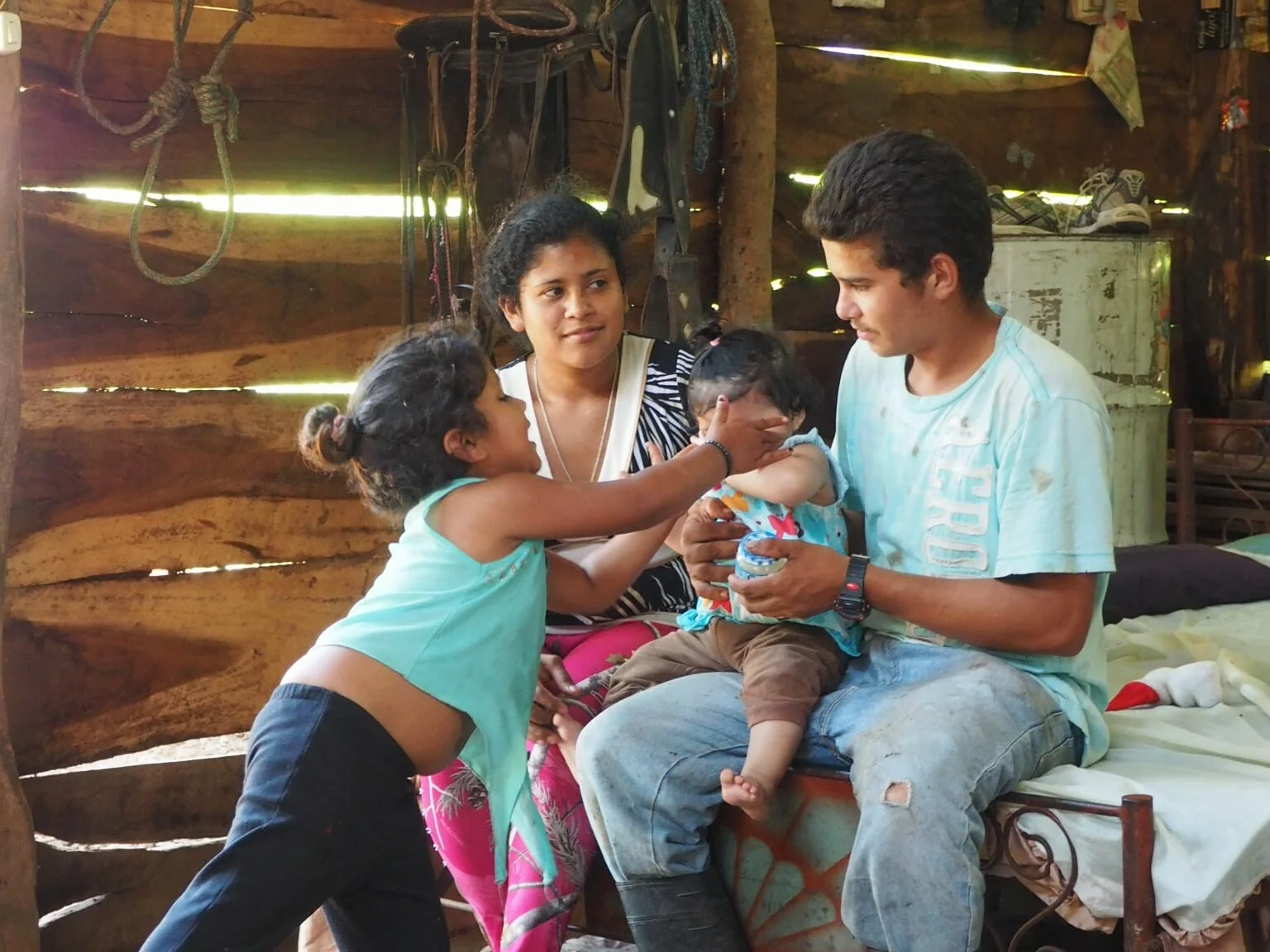
This is Alejandro (23) with his wife Maria (19), their infant daughter and Alejandro's niece. They live in a section of Isiquí called El Carizo, which is only reachable via a steep, 30min hike from the center of the village. They have no running water, no latrines and the only electricity available is provided by a solar panel. They would have loved to host two Venturers, but our project partner deemed El Carizo unsafe, claiming that "the people of El Carizo go out to drink and party on the weekends".